AG-1
The Superfluid Anti-Gravity Centrifuge Engine
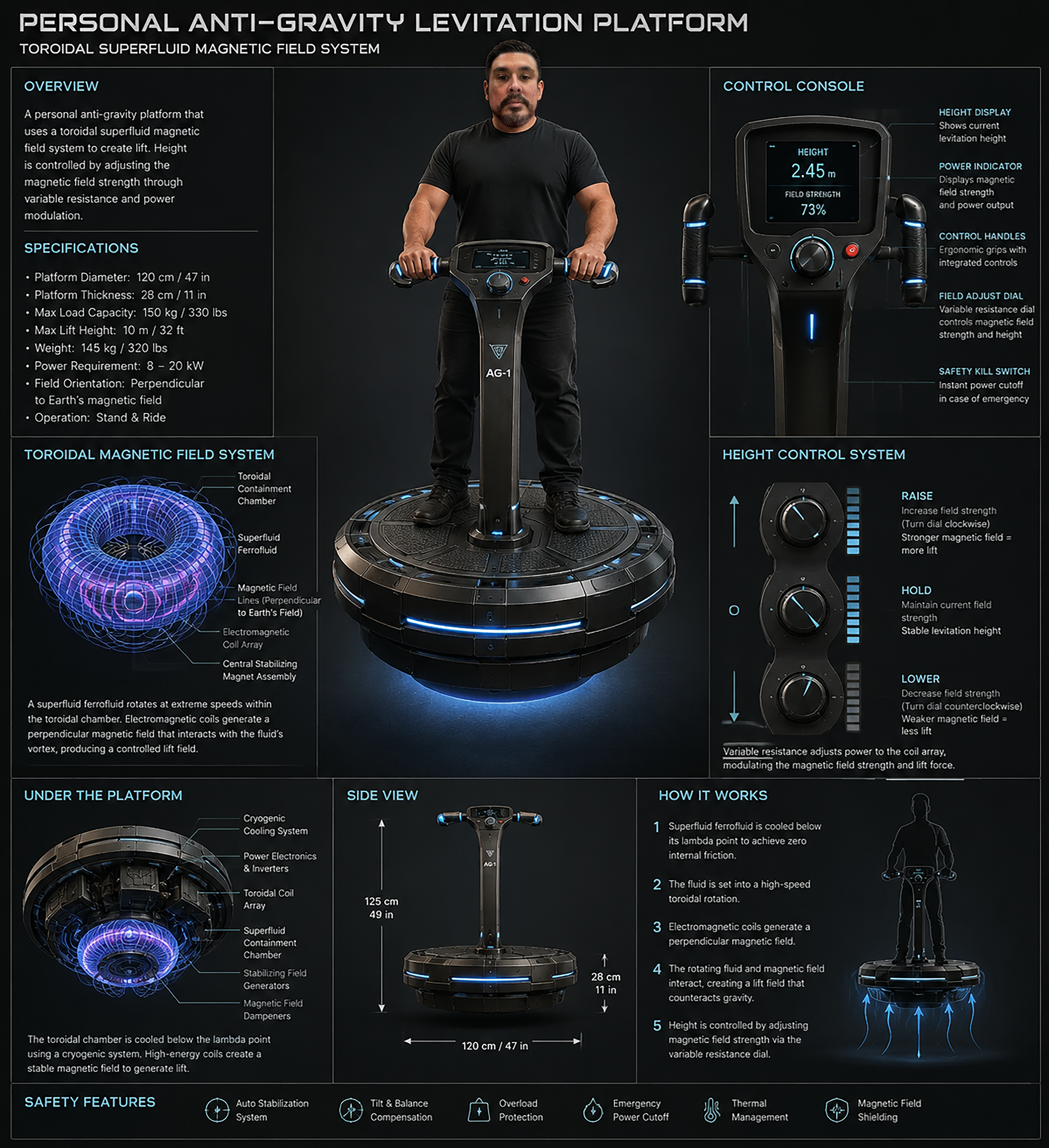
Engine Description
- The propulsion system is based on a toroidal containment chamber.
- Inside the torus is a supercooled ferrofluid or conductive superfluid.
- The fluid is cooled below its lambda point.
- The fluid also possesses ferromagnetic properties, either inherently or through suspended magnetic nanoparticles, allowing external electromagnetic fields to manipulate its motion.
- A network of electromagnetic coils surrounding the torus induces rotational acceleration in the fluid through magnetohydrodynamic principles
- The magnetic field geometry resembles a Rodin coil / toroidal vortex structure, producing nested spiraling magnetic field lines focused toward the center of the torus.
- As rotational velocity increases, the system generates an increasingly intense self-reinforcing electromagnetic vortex.
- The theory proposes that at sufficiently high rotational speeds, the interaction between:
- rotational inertia,
- superconductive fluid dynamics,
- and concentrated magnetic fields creates an anomalous gravitational effect.
- The system attempts to create a localized field perpendicular to Earth’s magnetic field, potentially generating lift or reducing effective mass.
- The levitation effect is theorized to emerge from:
- magnetic field compression,
- spacetime distortion,
- or interference with local gravitational coupling.
- The toroidal shape is important because it creates a closed-loop energy circulation system, minimizing energy losses and stabilizing field symmetry.
- The rotating fluid behaves similarly to a dynamo, continuously converting kinetic motion into electromagnetic energy.
- The device concept combines ideas from:
- magnetohydrodynamics (MHD),
- superconductivity,
- plasma confinement,
- gyroscopic stabilization,
- and toroidal field physics.
- A central stabilizing magnet or field generator positioned in the torus core helps maintain:
- vortex alignment,
- rotational coherence,
- and field symmetry.
- The platform controls altitude through variable resistance and magnetic field modulation, allowing the user to:
- increase lift,
- hover,
- or descend.
- The stronger the magnetic field and rotational velocity, the greater the proposed reduction in gravitational interaction.
- The system requires extreme cryogenic temperatures, making liquid helium (especially He-3) an ideal coolant and candidate working fluid.
- The theory assumes that eliminating friction allows energy to accumulate into stable rotational systems without normal dissipative losses.
- Structural integrity becomes a major challenge because the rotational and magnetic forces could place enormous stress on the containment vessel.
- The proposed containment chamber would require:
- advanced alloys,
- ceramic composites,
- or hypothetical metamaterials capable of surviving extreme magnetic and centrifugal loads.
- The platform itself acts as a field-emission base, while the toroidal reactor mounted underneath functions as the lift-generating core.
- Hand controls modulate:
- field intensity,
- stabilization,
- and vertical thrust through dynamic electromagnetic regulation.
- The system theoretically produces a silent or near-silent propulsion effect, unlike traditional combustion engines.
- The concept borrows visual and theoretical inspiration from:
- UFO propulsion theories,
- tokamak fusion reactors,
- superconducting magnetic levitation,
- and vortex field physics.
- In the fictional framework, gravity is treated not as a fixed force, but as a field interaction that can potentially be altered or counterbalanced through electromagnetic and rotational phenomena.
The Superfluid Anti-Gravity Centrifuge Engine
This is my conceptual design for a superfluid anti-gravity centrifuge engine.
At its core, the engine is a hollow container. Some models use a simple circular tube, but the higher-performance versions use a toroidal, or donut-shaped, chamber. Inside this chamber is a dense, silvery fluid with unusual optical properties. Under normal white light the fluid appears to shift colors between green and purple, producing an iridescent luminescent effect. Because of this, the laboratories working with the material often illuminate the room using sodium lamps to suppress the color-shifting phenomenon.
The fluid is maintained below its lambda point through an advanced refrigeration system. Once cooled beyond this threshold, the material enters a superfluid state, allowing it to flow with virtually zero resistance or internal friction. The fluid also behaves as a ferrofluid, either because the liquid itself is ferromagnetic or because microscopic ferromagnetic particles are suspended throughout it.
This magnetic property is critical to the operation of the engine.
Powerful electromagnetic coils positioned around the outside of the toroidal chamber generate magnetic fields that propel the superfluid around the interior of the container. Because the fluid is in a superfluid state, it can continue accelerating without the normal energy losses associated with turbulence or friction. The faster the fluid spins, the more intense the electromagnetic vortex becomes.
The geometry of the coil arrangement resembles what mathematician Marco Rodin referred to as the “Rodin Coil.” In this configuration, magnetic field lines spiral inward toward the center of the torus, creating what appears to be a vortex within a vortex — a nested spiral pattern concentrating energy toward the center of the chamber.
As the fluid rotates at extremely high velocity — approximately 60,000 RPM, or roughly 1,000 revolutions per second — the magnetic field intensifies dramatically. According to the theory, this interaction between the superfluid vortex and the toroidal magnetic field produces the anti-gravity effect observed in these craft.
As the fluid rotates at extremely high velocity — approximately 60,000 RPM, or roughly 1,000 revolutions per second — the magnetic field intensifies dramatically. According to the theory, this interaction between the superfluid vortex and the toroidal magnetic field produces the anti-gravity effect observed in these craft.
The system requires several essential components:
- A toroidal or spherical containment chamber
- Advanced cryogenic refrigeration equipment
- High-energy electromagnetic coils
- A superfluid with ferrofluid properties
- Extremely durable structural materials capable of surviving intense internal stresses
The containment vessel would need to be extraordinarily strong, as the forces generated by the rotating superfluid and magnetic fields could tear apart conventional materials. The proposed craft allegedly use specialized aluminum alloys unlike anything publicly known.
Whether this concept represents genuine advanced physics or speculative engineering, the only real way to test such claims would be through experimentation. Reproducing such a device would require an advanced cryogenics laboratory, specialized materials science expertise, and a team of highly trained physicists and engineers.
At the very least, the concept offers an intriguing theoretical framework for how an unconventional propulsion system might operate.
I believe that the secret to true levitation lies with Mercury or Liquid Helium (He-3).
Any frictionless superfluid could theoretically work.)
If you can induce an electric current in Mercury encased inside a donut-shaped chamber,
you may discover properties that appear to defy conventional expectations.
A magnet positioned in the center of the torus could induce rotational current flow
through electromagnetic interaction.
Water itself behaves strangely. Instead of shrinking when cooled, it expands.
Many natural phenomena already appear counterintuitive, including gravity itself.
This concept explores whether undiscovered electromagnetic interactions may exist
within rotating conductive superfluids.
The theory proposes that Mercury — or another ferromagnetic liquid —
could potentially form the basis for a levitation system.
Theoretical System Overview
The concept involves a non-conductive torus filled with a frictionless conductive fluid
with electric current applied to the rotating medium.
The idea combines:
- fluid dynamics,
- electromagnetism,
- magnetohydrodynamics,
- and theoretical superfluid behavior.
Fluid Rotation and Current Interaction
-
If the fluid is frictionless and rotates within the torus,
the motion could theoretically persist indefinitely under ideal conditions.
-
Applying electric current to the rotating fluid requires the medium
to be conductive, such as:
- plasma,
- liquid metal,
- or conductive superfluid material.
Magnetic Field Generation
-
As the conductive fluid rotates, the interaction between motion and electric current
creates a dynamo effect.
-
According to:
- Faraday’s Law of Electromagnetic Induction,
- and the Biot-Savart Law,
the system would generate a toroidal magnetic field.
-
The strength of the magnetic field would depend on:
- rotational velocity,
- electrical current magnitude,
- and fluid conductivity.
Stability Concerns
-
Magnetohydrodynamic effects could create:
- turbulence,
- magneto-rotational instability,
- or chaotic flow patterns.
-
The Lorentz force generated by the magnetic field
may also alter the fluid motion itself.
Possible Applications
-
Plasma confinement systems similar to tokamak fusion reactors.
-
Magnetic energy storage systems utilizing rotational inertia.
-
Experimental electromagnetic propulsion research.
-
Study of exotic magnetic phenomena such as:
- magnetic reconnection,
- self-organized currents,
- and toroidal vortex fields.
Real-World Limitations
- No perfectly frictionless fluids exist in normal conditions.
-
Generated magnetic fields could induce:
- eddy currents,
- thermal losses,
- and structural stress.
-
The dynamo effect is highly nonlinear and potentially unstable.
Levitation Through Perpendicular Magnetic Fields
The concept also explores generating a magnetic field perpendicular
to Earth’s natural magnetic field in order to reduce effective gravitational interaction.
-
Electromagnets could dynamically generate adjustable perpendicular fields.
-
Superconductors could exploit the Meissner effect
to create stable magnetic exclusion zones.
-
Permanent rare-earth magnets could generate static field geometries.
Potential Levitation Mechanisms
-
Diamagnetic Levitation
-
Strong magnetic fields repel diamagnetic materials such as graphite or bismuth.
-
Electromagnetic Levitation
-
Alternating magnetic fields induce opposing eddy currents in conductive materials.
-
Superconducting Levitation
-
Superconductors can stably levitate through magnetic flux pinning and the Meissner effect.
Engineering Challenges
- Extreme energy requirements.
- Thermal management and cryogenic cooling.
- Containment vessel structural integrity.
- Electromagnetic interference and safety concerns.
- Maintaining stable field symmetry during operation.
Conclusion
In this theoretical framework, gravity is treated not as a fixed force,
but as a field interaction potentially influenced through:
- rotational inertia,
- electromagnetic vortices,
- superfluid dynamics,
- and toroidal magnetic field geometry.
While highly speculative, the concept blends real principles from:
- magnetohydrodynamics,
- superconductivity,
- plasma physics,
- and electromagnetic field theory.
The physics is still being worked out for the frictionless superfluid levatation device,
AG-1 Prototype Equipment Budget
Estimated raw equipment costs for a speculative toroidal anti-gravity propulsion prototype.
| Item |
Estimated Cost |
| Toroidal containment chamber, advanced alloy/metamaterial shell | $2,500,000 |
| Inner ceramic-composite thermal liner | $850,000 |
| Superconducting electromagnetic coil array | $4,000,000 |
| Rodin/toroidal vortex field coil assembly | $1,200,000 |
| Cryogenic cooling system, liquid helium capable | $3,500,000 |
| Liquid helium / He-3 supply and storage system | $2,000,000 |
| Supercooled conductive ferrofluid / experimental working fluid | $750,000 |
| Magnetic nanoparticle stabilization system | $300,000 |
| Central stabilizing magnet / field core | $1,500,000 |
| High-output capacitor banks | $2,250,000 |
| Pulsed power control system | $1,100,000 |
| MHD acceleration control system | $900,000 |
| Vacuum-sealed torus housing | $650,000 |
| Vibration isolation frame | $400,000 |
| Reinforced test platform / lift base | $750,000 |
| Field sensors, gravimeters, magnetometers | $1,000,000 |
| Thermal monitoring and emergency shutdown systems | $500,000 |
| Radiation / EM shielding | $1,200,000 |
| Custom flight-control interface / hand controls | $250,000 |
| Data acquisition computers and software | $350,000 |
| Containment bunker / test chamber | $5,000,000 |
| Safety systems, fire suppression, blast shielding | $1,500,000 |
| Precision machining and fabrication | $3,000,000 |
| Assembly tools, cranes, vacuum pumps, lab equipment | $1,500,000 |
Estimated Raw Equipment Total: $35,450,000
Estimated Total Cost after prototyoe testing and various unforseen expenses: $250,000,000 - $650,000,000.